
Fundamentally, saving Samoa’s environment comes down to one thing: caring enough about her to change the way we, as individuals, behave and also the way we, as a society, behave. In fact, humanity now has such a huge impact on the planet that many geologists are now terming the current geological period the “Anthropocene”, meaning humans are now in a position to make such significant changes to the planet’s geology, climate and environment that this is reflected in the rock strata. Unfortunately, the window for action is getting smaller and smaller as the impacts of global threats, including climate change and pollution, mount.
If we want to reduce our impacts we can start by thinking about our “ecological footprint” as individuals and as governments, businesses, and civil society groups (GFN 2023). The World Wide Fund for Nature defines ecological footprint as: “the impact of human activities measured in terms of the area of biologically productive land and water required to produce the goods consumed and to assimilate the wastes generated”. The footprint must also be considered in relation to what is called “biocapacity” which measures the capacity of a given area to generate renewable resources and to absorb any wastes generated by their consumption: in other words the ability to support a human population. Both are measured in global hectares (gha) per capita.

In Samoa, we have a relatively light ecological footprint, compared with the West where the average person in a developed country consumes four times more natural resources per person than we do. In fact, it is calculated that if everyone on the planet lived like the average American we would need four more planet earths to support us all. The reality however, is that people around the world, including in Samoa, aspire to Western consumption levels. Clearly the planet cannot support this as our global population exceeds 8 billion people and with 70 million people added every year.
The problem in Samoa is that even though our ecological footprint is lower than the global average at 2.52 gha/capita in 2022 (the global average is 3.17 gha/capita), our biocapacity is even lower at 1.82 gha because we have a relatively small land and marine area for our population (GFN 2023). We simply don’t have the capacity to generate enough renewable natural resources to satisfy our current consumption levels and to absorb all our waste. Samoa essentially has an “ecological deficit”. This means that our population’s demand for natural resources exceeds its supply, which can lead to future resource shortages (including basics such as food and shelter), higher prices, and elevated levels of pollution in the air, water, and soil, unless we change something.

What can we do as individuals or as organisations to reduce our ecological deficit and achieve ecological balance? Here are a few practical steps most people can implement, many of which actually save money:
Reduce and manage waste
- Reduce, re-use, recycle, and compost waste
- Don’t burn waste or dump rubbish in the sea, rivers or forest
- Reduce use of plastic bags, packaging and bottles – use re-usable shopping bags and water bottles and drink tap water (if safe)
Save energy, water and money
- Switch off lights, appliances and the tap if not in use
- Fix leaky pipes or install water tanks to save water
- Use ceiling or desk fans instead of air-conditioners, or only use air con units during the hottest time of the day
- Use energy-saving light bulbs, electronic items and energy star certified appliances
- Conduct financial transactions and communications via online platforms
- Car pool or use public transport to reduce fuel use and gas emissions
Save our biodiversity and sustain our natural resources
- Don’t kill native animals protected under law (e.g. pigeons, flying foxes and undersize marine species)
- Offset your carbon emissions and promote biodiversity by planting native trees in your garden, village, school or farm
- Visit Community Conservation Areas and National Parks and support Samoan communities practising conservation
Given that humans are a social species and have designed complex institutions to manage most aspects of our lives, there are also actions that broader groups such as the public service, companies, churches, schools and civil society in general can do to reduce their ecological footprints. The Samoa Conservation Society can provide advice to implement measures such as designing and implementing an office greening policy, reducing, re-using and recycling waste, communicating and paying bills via online platforms, conducting energy and carbon audits, monitoring office energy usage and reducing it via energy efficiency measures and offsetting emissions that cannot be avoided by planting trees in community conservation areas.
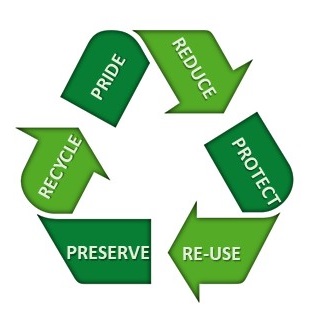
3Rs and 3Ps logo.
Copyright Samoa Conservation Society
 samoaconservationsociety.com